Solar Components Explained

Solar Components Explained
Solar Panels
It is no secret that solar panels and related solar equipment like solar inverters, and batteries are a hot commodity in South Africa.
Considering our grid is pretty unstable, owning a Solar Power Kit has become a necessity for most South Africans to function in our day-to-day lives properly. Our climate is also perfect for producing solar power.
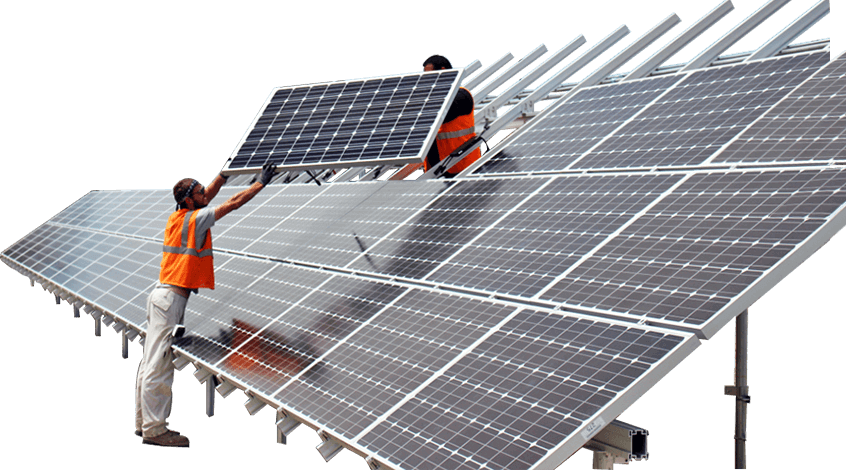
Here are the main types of panels you get:
Bifacial Panels
This is the latest technology we keep in stock and install.
Bifacial modules produce solar power from both sides of the panel. Whereas traditional opaque-back sheeted panels are monofacial, bifacial modules expose both the front and backside of the solar cells.
When bifacial modules are installed on a highly reflective surface (like a white TPO roof or on the ground with light-coloured stones), some bifacial module manufacturers claim up to a 30% increase in production just from the extra power generated from the rear.
You can read more about Bifacial Solar Panels HERE
Monocrystalline Panels
These have newer technology than Polycrystalline Panels.
Each solar PV cell is made of a single silicon crystal. These are sometimes referred to as “mono solar panels.”
Monocrystalline solar cells are more efficient because they are cut from a single source of silicon.
Monocrystalline solar panels are characterized by their black PV cells with rounded edges. They have a higher conversion efficiency than polycrystalline panels, which means they produce more kilowatt-hours of electricity. If you want to install a solar panel system but your space is limited, monocrystalline panels will be more productive per square foot. While they’re the most efficient solar panels, they’re also the most expensive, since the manufacturing process of single-crystal silicon cells is more complex.
Polycrystalline Panels
These have a single-crystal structure. Of the varieties we stock, they are the oldest technology.
Each PV cell is made of multiple silicon crystal fragments that are melted together during manufacturing. You may see them called “multi-crystalline panels” or “poly panels.”
Polycrystalline solar panels have blue-hued PV cells with straight edges. They have a lower efficiency compared with monocrystalline cells, which means you need more panels to reach the same power output. However, polycrystalline panels also have a lower price since their manufacturing process is simpler. Polycrystalline panels are exceptionally durable, but they tend to last slightly less than monocrystalline panels. They are also affected more by hot temperatures, which reduces their productivity on the hottest days.
Thin-film technology costs less than mono or poly panels but is also less efficient (efficiency means the percentage of energy that is converted into electricity).

Solar Inverters
Solar Inverters are the heart of any Solar Power or Load Shedding Kit.
The primary function of the Solar Inverter is to convert DC power into AC power which we use in our homes. Solar Batteries store DC power, so the inverter will also convert the energy coming from the battery into usable AC power.
Another task the inverter has is to manage the charge and discharge of your battery, ensuring the overall health of your Solar Power or Load Shedding system.
The main types of Inverters are classified as:
Hybrid Inverters charge batteries with energy from the modules or the grid. Any surplus energy can then be stored in the battery cells for later use.
Off-Grid Inverters are the sole powerhouse of a PV system with no connection to the grid as all energy comes directly from the solar panels.
Grid-Tied Inverters mean energy is sourced from the gid when there is insufficient power from the solar panels.
Solar Batteries
Solar Batteries are extremely popular in South Africa because they store either grid or solar power for later use, like when the grid goes down due to Load Shedding.

Lithium-ion Batteries are different from Lead batteries in not just their chemical makeup, but also in their performance. Lithium-ion batteries have a much longer life cycle (6,000 – 10,000 cycles) than Lead acid batteries; they also have a much deeper depth of discharge (80 – 100%) and are maintenance free.
Lithium-ion solar batteries use a different form of battery chemistry to other types of batteries. They are considered a “deep cycle” battery, due to their ability to be discharged more than once over the life of the battery. They have gained popularity because they offer both long lifespan and capacity, making them ideal for renewable energy applications that require more frequent discharges.
Lead acid batteries generally have a run time of between 5 and 6 hours. When they need to be recharged, that process takes approximately 8 hours. Although the charging process completes in 8 hours, another 8 hours of cooling down time is typically required.
Typically, the larger the current coming out of the charger, the faster the battery can fully recharge. The average time it takes to charge a sealed lead acid rechargeable battery is anywhere from 12 – 16 hours and up to 48 hours for large stationary batteries.
UPS is a kind of uninterruptible power supply with constant voltage and constant frequency, including energy storage device, taking the inverter as the main component, which is mainly used to provide uninterrupted power supply to a single computer, computer network system or other power electronic equipment. When the commercial power input is normal, UPS will stabilize the commercial power and supply it to the load
Hyper Solar is a Proud Member of:
Association for Renewable Energy Practitioners
Department of Labour
South Africa